How Much Does RV Storage Cost? Indoor, Outdoor & Covered Options
See RV storage cost ranges by type, size and U.S. region, uncover hidden fees, and calculate a realistic annual budget before you rent.

Quick answer: RV storage cost commonly falls into broad published bands of about $50-$200 per month for outdoor uncovered parking, $100-$250 for covered storage, and $150-$550 or more for indoor or enclosed space. Climate-controlled pricing is less consistently defined. Your payable total depends on rig size, market, availability, access, required insurance, fees, and whether the visible price is introductory.
The monthly RV storage cost is only the starting line. A low web rate may apply to a shorter space, a limited promotion, or a unit that cannot take your roof height. This guide separates current published benchmarks from a 12-metro price snapshot and gives you a first-year formula that exposes the extras.
How Much Does RV Storage Cost Per Month?
Current 2025-2026 operator and marketplace guides show wide RV storage prices because they do not all sample the same sizes, cities, promotions, or amenities. The table keeps their ranges separate instead of inventing one national median.
| Storage Type | Current Published Monthly Benchmarks | Annualized Base-Rent Band | Main Pricing Warning |
|---|---|---|---|
| Outdoor uncovered | About $50-$200 across current sources | $600-$2,400 | Lowest listed price may be a shorter space or limited inventory |
| Covered | About $100-$250 | $1,200-$3,000 | Roof coverage varies; open sides and electricity may change the quote |
| Indoor or enclosed | About $150-$550+, depending on size and market | $1,800-$6,600+ | Door height, unit depth, and shared versus private space matter |
| Climate-controlled | No defensible apples-to-apples national band in the checked pages | Quote and annualize |
Indoor does not automatically mean climate-controlled |
The Extra Space Storage guide lists typical ranges of $99-$119 for outdoor, $121-$216 for covered, and $180-$309 for indoor, with climate control often adding $25-$50 per month. Neighbor's current guide publishes wider bands of $75-$200, $100-$250, and $150-$550. RecNation lists $50-$100, $100-$150, and $150-$300+, while StoreSafe's Knoxville page shows a local market where covered-with-electricity pricing runs higher.
Those are published benchmark ranges, not ONNAIS facility-quote medians. Base rent also excludes any fee or add-on not included on the source page.
Our 2026 U.S. RV Storage Price Snapshot
The original brief called for 60 facility quotes normalized to a 30-35-foot RV. The public pages available on August 9, 2026 did not meet that standard across all 12 metros. Many pages mixed sizes and storage types or required a call before showing a comparable quote.
Rather than backfill missing cells, this article uses a narrower reproducible snapshot: current city-level RV/boat storage averages and lowest starting prices published by one operator across the 12 target metros. It is useful for market comparison, but it is not a census and does not isolate 30-35-foot spaces.
Reproducible Sampling Method
- Use the 12 metros from the brief and group them under the U.S. Census regions.
- Use one current Extra Space Storage RV/boat city page per metro so the wording and price definition stay as consistent as possible.
- Record the average monthly RV/boat storage cost stated in the current body and the current
starts as low asfigure. - Treat New York as the proxy for the New York/Newark metro. Do not blend the two city pages without facility-level records.
- Do not treat the starting price as a 30-35-foot quote, an ongoing rate, or the same storage type in every city.
- Calculate regional medians from three city averages and the national median from all 12 city averages.
- Report the limitation instead of estimating a missing size, fee, or storage-type split.
Prices checked: August 9, 2026.
| Census Region | Metro Page | Published Average / Month | Lowest Listed Start | Source |
|---|---|---|---|---|
| Northeast | Boston | $218 | $71 | Boston RV/boat storage |
| Northeast | New York proxy | $233 | $92 | New York RV/boat storage |
| Northeast | Philadelphia | $116 | $41 | Philadelphia RV/boat storage |
| Midwest | Chicago | $114 | $35 | Chicago RV/boat storage |
| Midwest | Minneapolis | $167 | $85 | Minneapolis RV/boat storage |
| Midwest | Kansas City | $87 | $74 | Kansas City RV/boat storage |
| South | Atlanta | $112 | $44 | Atlanta RV/boat storage |
| South | Dallas | $105 | $31 | Dallas RV/boat storage |
| South | Orlando | $148 | $48 | Orlando RV/boat storage |
| West | Phoenix | $137 | $22 | Phoenix RV/boat storage |
| West | Denver | $96 | $42 | Denver RV/boat storage |
| West | Los Angeles | $267 | $43 | Los Angeles RV/boat storage |
What the Regional Results Show
| Region | Median of Three Published City Averages | n |
|---|---|---|
| Northeast | $218 | 3 |
| Midwest | $114 | 3 |
| South | $112 | 3 |
| West | $137 | 3 |
| All 12 metros | $127 | 12 |
The middle 50% of the 12 published city averages runs from about $109 to $193 per month. Annualized, the 12-metro median is about $1,518 in base rent before mandatory fees or add-ons.
Three findings are worth keeping in perspective:
- The Northeast median is highest in this small panel, but Philadelphia is far below Boston and New York.
- Los Angeles lifts the West, while Denver is below the national panel median.
- Lowest starting prices do not track neatly with city averages. They are inventory signals, not normalized quotes.
This snapshot compares one operator's mixed RV/boat inventory. It does not prove what a specific 35-foot motorhome will cost in every metro.
RV Storage Cost by Storage Type
Define the product before comparing the price. A facility can use familiar labels for very different spaces.
| Type | What It Usually Means | Weather Exposure | Security Boundary | Best Fit |
|---|---|---|---|---|
| Outdoor uncovered | Marked parking space on an open lot | Full sun, rain, wind, snow, and airborne debris | Facility perimeter plus owner-installed RV hardware | Lowest-budget option when local rules and RV condition permit |
| Covered | Roof over a parking bay, often with open sides | Less direct sun and overhead precipitation; sides remain exposed | Same basic perimeter model, sometimes with assigned bays | Owners who want roof protection without enclosed pricing |
| Indoor or enclosed | Private unit or shared building space | Much lower direct weather exposure | Building or unit door adds another boundary | Higher-value RVs, long storage, or owners prioritizing weather protection |
| Climate-controlled | Indoor space with stated temperature or humidity management | Controlled according to the facility's published definition | Same indoor boundary plus environmental system | Sensitive interiors or long storage where the controls are verified |
Outdoor Uncovered Storage
Outdoor RV storage cost is usually the lowest because the facility provides space and site controls without a roof or building. That does not make it unsafe by definition. Ask about pavement or gravel, drainage, lighting, gates, camera coverage, access hours, and how much room you have to turn.
Covered RV Storage
Covered RV storage cost pays for the roof and, sometimes, a wider bay or electricity. The roof helps with overhead sun and precipitation, but wind-driven rain and side exposure remain. Confirm whether roof height includes rooftop air conditioners and antennas.
Indoor or Enclosed RV Storage
Indoor RV storage cost can mean a private garage-like unit or a place inside a shared building. Verify usable length, door width, door height, aisle width, and whether you can extend slides. A 40-foot unit with a 12-foot door is not a 40-foot motorhome solution if the roof equipment needs 13 feet.
Climate-Controlled RV Storage
Climate-controlled storage is an additional feature, not a synonym for indoor. Ask for the actual temperature or humidity range and how it is monitored. If the facility cannot define the control, price it as ordinary indoor storage until it can.
RV Storage Prices by RV Length and Space Size
Facilities commonly publish parking sizes such as 10x20, 10x30, and 10x40, but the usable fit depends on more than nominal length.
| RV Length | Starting Space to Investigate | Main Fit Check |
|---|---|---|
| Under 25 ft | 10x25 or nearest larger space | Hitch, ladder, spare tire, and parking clearance |
| 25-30 ft | 10x30 or larger | Actual end-to-end measurement and door height if indoor |
| 30-35 ft | 10x35 or 10x40 | Turning room, rooftop equipment, and facility size bands |
| 35-40 ft | 10x40 or larger | Width, height, rear overhang, and access aisle |
| Over 40 ft | Operator-confirmed oversized space | Pull-through access, turning radius, and complete dimensions |
Measure the bumper, hitch, ladder, mounted spare, rear rack, roof air conditioner, antenna, and mirrors. For motorhome storage, ask whether the quoted length is the painted line, usable parking area, or unit interior. For camper storage, include the tongue and anything mounted behind the trailer.
Do not assume linear-foot pricing. Use it only when the facility's current quote or contract actually prices by the foot.
What Is the True First-Year RV Storage Cost?
The cost to store an RV for a year is not always twelve times the web headline.
First-year cost = recurring rent after promotions + mandatory insurance + one-time fees + required add-ons + taxes shown
Use this worksheet:
| Variable | Meaning | Your Quote |
|---|---|---|
$M |
Standard monthly rent | ______ |
$P |
Promotional monthly rent | ______ |
$N |
Number of promotional months | ______ |
$I |
Mandatory monthly insurance | ______ |
$E |
Monthly electricity or required add-on | ______ |
$F |
Non-refundable setup/admin/lock fees | ______ |
$T |
Taxes shown for the year | ______ |
$D |
Refundable deposit, tracked separately | ______ |
Formula with a promotion:
First-year non-refundable cost = ($P x $N) + [$M x (12 - $N)] + (12 x $I) + (12 x $E) + $F + $T
Then divide by 12 for the effective monthly cost. Keep $D outside the cost total unless the contract makes some or all of it non-refundable.
This model works for seasonal storage too. Replace 12 with the actual number of paid months and include any minimum term. Never assume insurance, tax, electricity, or a rate increase applies. Put it into the calculation only when the quote or contract says it does.
What Changes RV Storage Rates?
-
Storage type. Verify whether
indooris private, shared, or climate-controlled. - Metro and land cost. Compare facilities within a realistic drive, not just one ZIP code.
- RV dimensions. Confirm usable length, width, height, and turning radius.
- Availability. Ask whether the quote is for an available space or a waitlist.
- Access hours. Restricted access can cost less or simply be inconvenient.
- Electricity and services. Confirm electrical hookup, wash, dump, tire-air, and battery-charging charges.
- Security features. Ask what cameras, lighting, gates, access logs, and on-site staffing actually cover.
- Contract length. Compare month-to-month, seasonal storage, and long-term storage on effective cost.
- Promotions. Record the regular rate and the exact month the discount ends.
- Required fees. Read insurance, administration fees, deposits, taxes, and cancellation terms.
Indoor vs. Covered vs. Outdoor: Which Option Is Worth It?
| Choose | When It Usually Fits | Main Tradeoff |
|---|---|---|
| Outdoor uncovered | Budget leads, the RV tolerates exposure, and local availability is good | Highest weather exposure |
| Covered | You want roof protection without paying indoor RV storage cost | Open sides and variable bay clearance |
| Indoor/enclosed | Long storage, higher-value condition, or weather protection matters most | Highest price and tighter fit constraints |
The right choice is not automatically the most expensive one. Compare the indoor RV storage cost, covered RV storage cost, and outdoor RV storage cost against the RV's condition, local weather, storage duration, visit frequency, and available space.
Read the full indoor vs. outdoor RV storage comparison when weather and security tradeoffs matter more than the monthly rate alone.
How to Lower Your RV Storage Cost
- Compare the effective annual cost, not the first-month banner.
- Ask for the regular non-promotional monthly RV storage cost in writing.
- Measure accurately so you do not pay for unnecessary length.
- Evaluate annual prepay only after reading cancellation and refund terms.
- Remove optional electricity or service add-ons you will not use.
- Join a waitlist for the right-sized outdoor, covered, or seasonal storage option.
Budget for Storage Security and Return Access
Rent pays for the storage space and the controls named in the contract. Owner-controlled measures remain a separate line item.
| Facility-Provided Controls to Verify | Owner-Controlled Measures to Budget |
|---|---|
| Gate and access hours | RV entry-door and compartment locks |
| Cameras and stated coverage | Hitch, coupler, wheel, or steering locks as applicable |
| Lighting and perimeter | Battery maintenance and a backup entry plan |
| Access logs or individual codes | Valuables removed or kept out of sight |
| On-site staff or patrol schedule | Photos, condition records, and periodic inspections |
| Insurance requirements | Separate insurance review and current contact details |
These layers handle different risks. No door lock replaces the storage facility's perimeter, a suitable insurance policy, or periodic inspection. Use the broader RV security guide when building the full storage checklist.
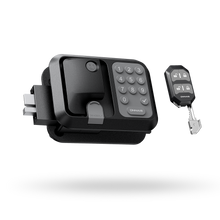
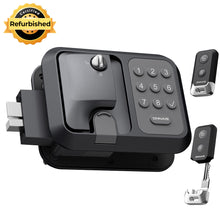
Guard Smart is one optional return-access upgrade with a Bluetooth app, keypad, remote fob, and mechanical key. The app can check battery level, manage fobs, share access, and create up to 10 one-time passwords. Measure first: it needs a 3.75 x 2.75-inch opening and a 1.25 to 1.5-inch door. It does not fit Class A RVs, Class C two-pin doors, or left-hinged doors. The Guard Smart RV keyless door lock is weather-resistant, not fully waterproof.
Use the RV lock maintenance checklist before long storage, and check RV door lock fit before purchasing hardware.
Questions to Ask an RV Storage Facility Before You Sign
- What is the regular monthly rate after the promotion?
- Which fees, insurance, taxes, deposits, or add-ons are mandatory?
- What are the exact usable dimensions and clearance?
- Is this exact space currently available?
- What are the access hours and restrictions?
- How much notice is required before a rate change?
- What insurance evidence is required?
- What are the cancellation and refund terms?
- Which security controls cover this RV storage unit?
- Are electricity, condition checks, or vehicle-start requirements in the contract?
RV Storage Cost FAQs
Is RV storage cheaper if I pay annually?
Sometimes, but only when the annual discount exceeds the value of flexibility. Compare the effective annual RV storage rates and read cancellation and refund terms before prepaying.
Does RV storage include insurance?
Not universally. A storage facility may require proof of coverage or sell storage insurance separately. Use the written quote and contract, not an assumption based on the headline price.
Is covered RV storage considered indoor?
No. Covered RV storage normally has a roof with open sides. Indoor or enclosed storage places the RV inside a private unit or shared building.
How often can RV storage rates increase?
Policies vary by facility and contract. Ask how notice is delivered, whether increases can occur during the initial term, and which price applies after a promotion ends.
Compare the Payable Total, Not the Headline Rate
To compare RV storage cost honestly, normalize the size and type, calculate the dated annual total, verify access and security, and read the contract before paying.